The 25 weirdest units of measurement
The weirdest units of measurement include the smoot (the height of an MIT student, used to measure a bridge), the shed (a joke unit of area equal to 1 × 10−52 square metres), the potrzebie (the thickness of one issue of MAD magazine) and the degree Delisle (a temperature scale that runs backwards).
This list picks 25 of the 223 units in the Cabinet of Weird Units. Some are pranks that stuck, some are real scientific units with joke names, and some are old units that worked in ways that seem strange now. Each one links to its full page with its history and sources, and to the converter. The list is grouped by kind, not ranked.
Joke units invented by scientists and students
-

1. Smoot
A smoot is a unit of length equal to about 1.7018 metres (5.58333 feet).
In 1958 MIT freshman Oliver Smoot was laid end to end along the Harvard Bridge, which came out at 364.4 smoots, plus or minus one ear. Smoot later became president of the International Organization for Standardization (ISO).
-

2. Beard-second
A beard-second is a unit of length equal to about 3.28084 × 10⁻⁸ feet.
The light-year's joke cousin: how far an average beard grows in one second. One beard-second is smaller than the smallest viruses.
-

3. Furlong per fortnight
A furlong per fortnight is a unit of speed equal to 0.000598714 kilometres per hour (0.00016631 metres per second).
The speed unit of the joke furlong–firkin–fortnight system. It is almost exactly 1 centimetre per minute.
-

4. Potrzebie
A potrzebie is a unit of length equal to about 0.00226335 metres (0.00742568 feet).
The thickness of issue 26 of MAD magazine, from a system of units a 19-year-old Donald Knuth sold to MAD in 1957. It was his first published work.
-

5. Microcentury
A microcentury is a unit of time equal to 3,155.76 seconds (0.8766 hours).
One millionth of a century, about 52.6 minutes: a joke for the length of a lecture, popularly attributed to Enrico Fermi.
-

6. Attoparsec
An attoparsec is a unit of length equal to 0.0308568 metres (0.101236 feet).
An astronomical distance shrunk by the prefix atto- (10⁻¹⁸) until it is about an inch and a quarter.
-
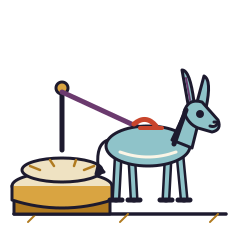
7. Donkeypower
A donkeypower is a unit of power equal to 250 watts (0.25 kilowatts).
If a horse is worth one horsepower, a donkey should be worth less: a round 250 watts, so roughly three donkeys make a horse.
-
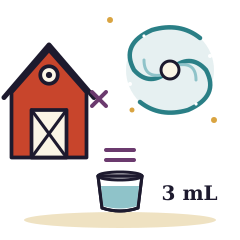
8. Barn-megaparsec
A barn-megaparsec is a unit of volume equal to 0.00308568 litres (0.626035 US teaspoons).
A tiny nuclear area multiplied by a vast distance between galaxies, which comes out at about two thirds of a teaspoon.
-

9. Sheppey
A sheppey is a unit of length equal to about 1,408.18 metres (4,620 feet).
From Douglas Adams and John Lloyd's The Meaning of Liff: the closest distance at which sheep remain picturesque.
-

10. Pirate-ninja
A pirate-ninja is a unit of power equal to about 40.5518 watts (0.0405518 kilowatts).
Invented in Andy Weir's novel The Martian: one kilowatt-hour per Martian day. Weir said the Curiosity rover team at JPL really budgets power in watt-hours per sol.
Real science with silly names
-

11. Barn
A barn is a unit of area equal to 1 × 10⁻²⁸ square metres.
Named over a cafeteria dinner during the Manhattan Project because, for a nucleus, 10⁻²⁸ square metres is as big as a barn. Its inventors rejected 'Oppenheimer' as too long.
-

12. Shed
A shed is a unit of area equal to 1 × 10⁻⁵² square metres.
The barn's joke outbuilding. It takes a trillion trillion sheds to make one barn.
-
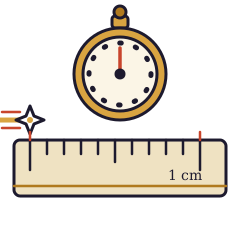
13. Jiffy (light-centimetre)
A jiffy is a unit of time equal to 3.33564 × 10⁻¹¹ seconds.
Chemist Gilbert N. Lewis made the everyday word a unit in 1926: the time light takes to travel one centimetre. Among hackers, 'in a jiffy' means certainly not now and possibly never.
-

14. Foe (bethe)
A foe is a unit of energy equal to 2.77778 × 10³⁷ kilowatt-hours.
An acronym, F-O-E, for 'fifty-one ergs'. A typical supernova releases about one foe of observable energy.
-

15. Banana equivalent dose
A banana equivalent dose is a unit of radiation dose equal to about 1 × 10⁻⁴ millisieverts.
The radiation dose from eating one banana, thanks to its natural potassium-40. A truckload of bananas can set off the radiation monitors at US ports.
-
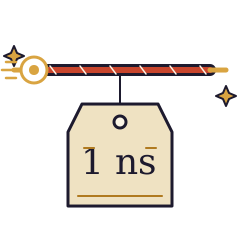
16. Light-nanosecond
A light-nanosecond is a unit of length equal to 0.299792 metres (0.983571 feet).
How far light travels in a billionth of a second, just under a foot. Grace Hopper handed out pieces of wire this long to show programmers why signals take time.
-

17. Siriometer
A siriometer is a unit of length equal to 1.49598 × 10¹⁷ metres.
One million astronomical units, proposed in 1911 for star distances. Despite its name, Sirius is only about 0.54 siriometers away.
Old units that worked differently
-

18. Helek
A helek is a unit of time equal to 3.33333 seconds (0.000925926 hours).
The Hebrew calendar splits the hour into 1080 parts of 3 1/3 seconds, because 1080 divides evenly by 2, 3, 4, 5, 6, 8, 9, 10 and 12.
-

19. Kalpa (day of Brahma)
A kalpa is a unit of time equal to about 3.78691 × 10¹³ hours.
One day in the life of Brahma, the Hindu creator god: 4.32 billion years.
-
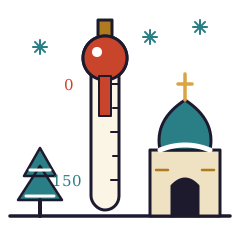
20. Degree Delisle
The degree Delisle is a temperature scale: 0 °D equals 100 °C (212 °F), and a rise of 1 °D is a fall of 0.666667 °C.
A thermometer scale with zero at boiling water that runs backwards: the hotter it gets, the lower the reading.
-

21. Degree Wedgwood
The degree Wedgwood is a temperature scale: 0 °W equals 580.833 °C (1,077.5 °F), and a rise of 1 °W is 72.2222 °C.
Potter Josiah Wedgwood measured kiln heat by how much clay cylinders shrank. His scale put the melting point of gold at least 1,400 °C too hot.
Measuring with places and people
-

22. Wales
Wales, used as a unit of area, is about 2,077,900 hectares.
Britain's favourite yardstick for big areas, especially lost rainforest. About six Waleses of tropical forest disappear each year.
-

23. Sydharb
Sydharb, used as a unit of volume, is about 500,000,000,000 litres.
Australia's unit for large amounts of water: the volume of Sydney Harbour, about 500 gigalitres. More than 586 species of fish live in the measuring cup.
-

24. Library of Congress (data)
The Library of Congress, used as a unit of data, is about 1 × 10¹³ bytes.
Reporters measure data in Libraries of Congress, usually 10 terabytes. The figure comes from a 2000 UC Berkeley study, which also gives 208 TB for the same collections.
-
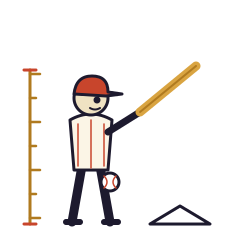
25. Altuve
An Altuve is a unit of length equal to 1.651 metres (5.41667 feet).
The height of Houston Astros star Jose Altuve, the shortest active player in Major League Baseball. The New York Times reported that Aaron Judge is 1.22 Altuves tall.
Try them in the converter
Every unit here converts to any other unit that measures the same thing. A few to start with: furlongs to smoots, furlongs per fortnight to the speed of light, donkeypower to horsepower and barn-megaparsecs to teaspoons. Or browse all 223 weird units.
Last updated